
Back in the Spring the exhibitions team at the Beacon Museum in Whitehaven was considering which public engagement opportunity to develop that could strongly reach out to local audiences. It soon became apparent, after the 80th Anniversary of VE Day in May, that a World War II exhibition was an ideal opportunity to do just that – given that so many people across the United Kingdon have World stories of family members’ involvement in the conflict. This was certainly the case in Whitehaven and its historical hinterland which has a strong record of military service within The Border Regiment and Westmorland and Cumberland Yeomanry.
As the Museum’s Curator, this was a fantastic opportunity to develop and deliver an engaging and informative exhibition. Given I am from a strong military family background with ties to the Coldstream Guards and Durham Light Infantry, and previously worked as the Regimental Curator of The Royal Scots Dragoon Guards Museum, I was keen to showcase the Museum’s extensive military collections. It also became clear that I could also use my background in social history curation to follow a ‘story led’ approach to interpretation.
As I began scouring primary and secondary sources for historical information, it became apparent that local people gave service to either the armed forces or in work on the home front, while huge solidarity was shown in times of great adversity. There were massive sacrifices made on the local way of life through measures like the blackout and rationing. Many brave soldiers, sailors and airmen also made the ultimate sacrifice in the fight for freedom against Nazi Germany, Fascist Italy, and Imperial Japan. Therefore, the key themes of Service, Solidarity and Sacrifice would form the title of the exhibition and be integral to its storyline and composition.
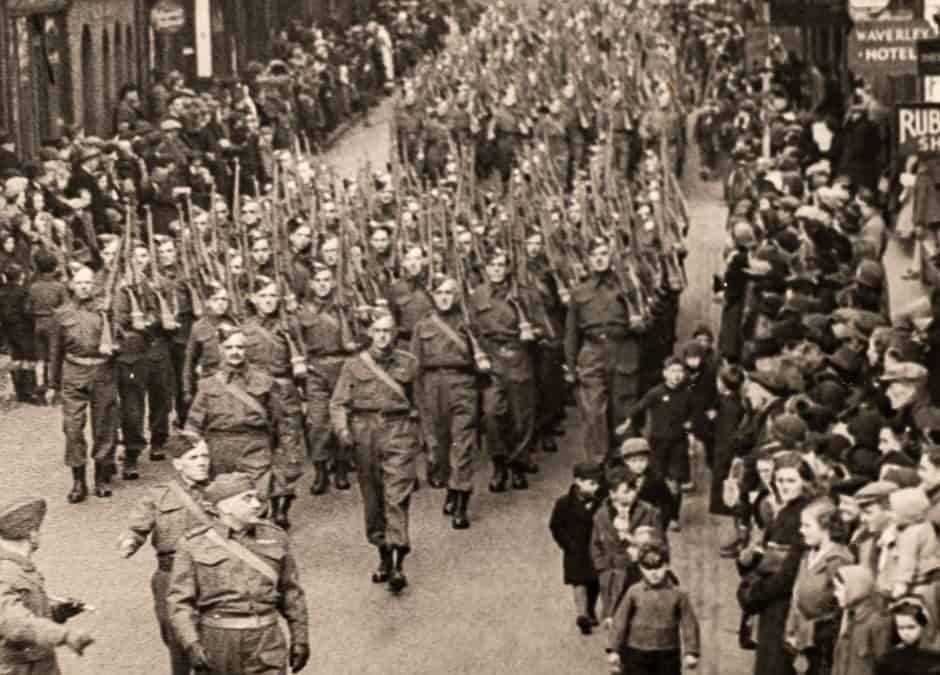
To successfully follow a story led approach, I wanted to focus on individual people’s experiences of World War II and therefore began to look for possible case studies. These biographical stories would work within broad thematic areas of the exhibition as it was also vitally important to give the national and local context through the development of thematic interpretation panels including RAF Millom, Whitehaven Harbour, Operation Pied Piper, ARP, Rationing and the Home Guard.
Soon through research in The Beacon Museum, Cumbria Archives, Whitehaven Library, and the Museum of Military Life in Carlisle I had identified several strong biographical stories – such as Royal Australian Air Force Lancaster Bomber Pilot Flying Officer Neville Emery who became the face of the Exhibition. Emery was very interesting in representing one of the men who came to Britain’s aid from the Dominions. He also was an outstanding sportsman and represented the Australian national rugby union team and was later recruited as Whitehaven Rugby League coach during the 1950s. Therefore, he was an ideal case study to choose. Then several other strong case studies were developed including :
Flight Lieutenant Bill Fowler who was in the crew of an RAF Whitley Bomber which was shot down over Germany in 1941. Bill became a Prisoner of War, but sadly two members of the crew were killed in the crash. After the war Bill returned to Long Yocking Cottage and produced Countryman’s Cooking in 1965, which is both a highly witty and highly regarded insight into rural life and cooking game food.
Sister Olga Baudot Rouville, a French Red Cross Nurse who helped many severely wounded British soldiers who were left behind after the evacuation from the beaches of Dunkirk in 1940. Olga was also secretly an operative within the Pat O’Leary Escape line that helped downed allied airmen escape from occupied France. This was a highly dangerous undertaking, and Olga could have been captured, tortured, and shot at any moment had the Nazi’s found out. After the war, Olga briefly lived near Cockermouth.
Following a visit to the Museum of Cumbria Life in Carlisle, Platoon Sergeant Vincent McSherry was identified as another case study. Sergeant McSherry served in the 1st Battalion Border Regiment and was on the Beaches at Dunkirk in 1940, in a glider on the invasion of Sicily in 1943, and part of a mortar team at Arnhem in 1944. He was wounded, captured, and treated in a German field hospital and then made a Prisoner of War. After the War Vincent McSherry returned to Whitehaven and was tragically killed along with 103 other men in the William Pit Disaster in 1947.
Following an appeal to local history societies, Sergeant Doug Phillips was then identified. He was a member of the Special Operations Executive who was parachuted into occupied Greece in 1942 and worked alongside Greek Partisans to destroy a series of railway bridges being used by the German Afrika Corps. In 1943 Phiilips was killed after explosive detonated prematurely while on a secret mission to destroy another bridge.
These case studies are integral to showcasing inspiring and moving stories about local people. Several members of the McSherry family have visited the exhibition to see the case study and other local audiences have connected with the case studies of Millom men such as Sergeant John Park, a Commando who was killed in action during a raid on Normandy in 1944.
It was also important to hear the voices of contemporaries that were involved in World war II and through the help of Carlisle Archives I was able to access and edit oral testimonies which provided a range of perspectives – including a young Woman from Manchester who joined the Women’s Land Army and worked in rural Cumberland; a member of the Border Regiment’s mortar team describing the Battle of Arnhem, an RAF Lancaster Bomber Gunner who bailed out over Germany and had an amazing escape story and also accounts of the Danish Fishing Fleet in Whitehaven. All these contemporary accounts were then made available through a touch screen in the exhibition.
Music was also key in setting the tone and mood of the exhibition in combination with audio-visual images from 1939-1945 from the Museum’s collection, Cumbria Archives, local history groups and Cumbria’s Museum of Military Life. Contemporary songs from Vera Lynn and Glen Miller, together with regimental marches of the Border Regiment and the Battle of Britan overture, are combined with moving music such as I vow to Thee My Country and Those in Peril on the Sea. The Last Post and Elgar’s Nimrod has also been used when the screen show’s Whitehaven’s Roll of honour to respect the town’s war dead.
In terms of the collections displayed I wanted to work across collections disciplines and therefore combined militaria, fine art, costume, and ship modes in the exhibition. The collections are displayed in two broad areas designated for the Home Front and the Active Front. Where possible each object is linked to a person, to follow the ‘story’ led approach to interpretation. Material on display has come from the Beacon Museum’s collection and has been carefully combined with loans from Local history groups, Cumbria Archives, and the Museum of Military Life in Carlisle. The costume really adds to the visual spectacle of the exhibition and connects to of the case studies. Wall colours have also been used to designate key displays within the exhibition that relate to the Home Guard, Royal Air Force, The British Army, and the Royal/Merchant Navy. Quotes of local contemporary people were selected from a previous museum oral history project and are situated throughout the exhibition to add to the focus on people’s war experiences. Many of these quotes are deeply moving as well as highly insightful.
The research in Cumbria Archives also uncovered a hidden history. The Whitehaven Aliens Tribunals of 1939 was fascinating to discover, and showed that Austrian, German and later Italian nationals living in the area were considered ‘enemy aliens’ by the British government. Such ‘aliens’ then had to register at a police station and sit before a panel of local dignitaries to determine whether they were considered a threat to national security. In 1939, most of these ‘enemy aliens’ were Jewish refugees fleeing Nazi persecution, for example many Austrian Jews fled from Vienna in 1938 to start a new life in Britain. One German Journalist named Justus Israel Schoenthal was regarded by the tribunal panel members as a threat to national security and was given a category ‘A’ status and interned. Tragically Schoenthal was killed when the SS Arandora Star holding a cargo of 479 interned Germans and 734 interned Italians was sunk by German U-Boat U-47 off the west coast of Donegal on route to Canada on 2nd July 1940.
The Museum was able to loan Alien Identification Cards to display in the exhibition following clearance from Cumbria Police, and these archives were made accessible to the public for the first time. This is one example of the many individual stories that are displayed within the exhibition’s thematic panels, case studies and object labels.
As the Curator of this exhibition, it has been a true privilege to discover, develop and showcase these powerful and inspirational war time stories of local people. Service, Solidarity and Sacrifice has been one of the most moving and rewarding projects I have ever worked on, and I am looking forward to creating further local history exhibitions and forging many new partnerships and collaborations. After this exhibition is complete, it would be rude not to look at the local area’s First World War experience at some stage.
I dedicate this blog to all those who gave service, showed solidarity, and made the ultimate sacrifice for the cause of freedom.
They shall grow not old, as we that are left grow old:
Age shall not weary them, nor the years condemn.
At the going down of the sun and in the morning
We will remember them.
Edwin Rutherford
Museum Curator
The Beacon Museum
Whitehaven